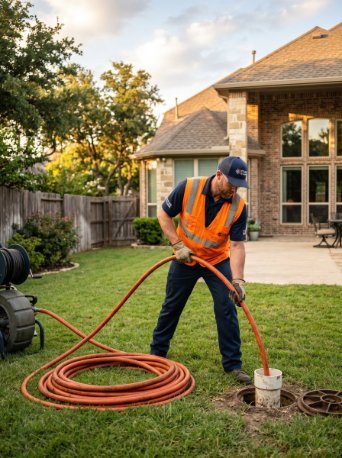
Hydro Jetting Rowlett TX Lake Ray Hubbard Roots • Clay Soil • Scale
Hydro jetting in Rowlett TX — strips grease, mineral scale, and root debris from pipe walls at high pressure. Rowlett TX lakeshore homes and commercial drain cleaning service.
Rowlett TX Development Eras — Drain Risk by Neighborhood
Rowlett TX has one of the longest development histories of any DFW suburb, spanning from original lakefront platting in the 1950s–1960s through active new construction today. Drain risk varies significantly by home age and proximity to Lake Ray Hubbard.
Highest Risk
1950s–1960s — Original Lake Ray Hubbard Shoreline Lots
Earliest Rowlett TX development along Lake Ray Hubbard waterfront
Possible clay tile or early cast iron sewer laterals — camera inspection critical before jetting
Cottonwood and willow trees 50–70 years old — largest root masses in the city
Elevated water table near lake keeps roots active year-round
Blackland Prairie clay soil stress at pipe joints since original installation
NTMWD calcite scale accumulating at PVC fittings since installation
Root-cutting hydro jetting recommended; camera before service advised
Moderate Risk
Late 1980s–2000s — Waterview, Dalrock Rd, Miller Road Areas
Schedule 40 PVC standard throughout — full hydro jetting pressure safe
Landscape trees 20–35 years old — increasing root reach toward drain lines
Blackland Prairie clay still aggressive — joint stress accumulating
NTMWD scale clearly visible at elbow and tee fittings after 20+ years
Grease and calcium soap the primary current blockage driver
Lower Risk
2010s–Present — Newer Rowlett TX Development
New Schedule 40 PVC in excellent condition
Young landscaping trees with immature root systems
NTMWD scale beginning to accumulate at newer PVC fittings
FOG and calcium soap the primary drain concern
Root risk will grow as landscaping matures through the 2030s
Two Factors That Make Rowlett TX Drain Lines Uniquely Vulnerable
Blackland Prairie Clay + Lake Ray Hubbard Root Species — A Compounding Problem
1
Blackland Prairie Vertisol Clay — Most Aggressive Soil in DFW: Rowlett TX sits on Blackland Prairie — the same expansive Vertisol clay that runs through much of east Dallas County. This clay swells significantly when wet and shrinks when dry, creating 15–35 wet-dry expansion cycles per year in normal North Texas weather. Each cycle slightly shifts the soil surrounding the sewer lateral. Over years, this movement stresses PVC gasket joints, causing micro-gaps that accumulate mineral deposits and provide root entry points. Older clay tile joints move even more dramatically under the same soil stress.
2
Lake Ray Hubbard Proximity Amplifies Root Aggression: Cottonwood and willow trees near Lake Ray Hubbard have a distinctive root behavior: the elevated water table near the lake keeps soil moisture available in the upper root zone year-round. This means these trees' root systems stay active and growing even during dry summer months when inland trees reduce root growth. A cottonwood or willow near a lakefront Rowlett TX home pursues drain line moisture 12 months a year rather than seasonally — making root intrusion faster and more consistent than in inland neighborhoods.
3
NTMWD Scale Creates and Holds Root Entry Points: NTMWD supplies Rowlett TX with water sourced from Lake Ray Hubbard and Lake Lavon at approximately 17 GPG hardness. This water deposits calcite at every PVC gasket joint along the sewer lateral — changing the seal geometry over years and creating micro-gaps that root hair tips enter. In softer-water cities, these entry points might self-seal; in NTMWD Rowlett TX they persist and widen as scale builds around them.
4
Root-Cutting Hydro Jetting Is the Only Complete Solution: A K-60 drain snake punches a temporary channel through a root mass inside the pipe but leaves the root material in place. The roots regrow from the existing mass within weeks to months. Root-cutting hydro jetting at appropriate pressure physically cuts and flushes the entire root mass out of the pipe, scours calcite scale from the pipe wall, and removes grease coating — all in a single service. Results last 2–4 years in most Rowlett TX wooded lot homes.
Older Rowlett TX Homes — Pipe Material Assessment Before Jetting
Rowlett TX homes built before approximately 1975 may have clay tile sewer laterals or early cast iron drain lines rather than PVC. These materials require camera inspection before hydro jetting to assess pipe condition and select appropriate jetting pressure. Clay tile in good condition can be jetted at controlled 1,500–2,500 PSI; clay tile with cracking or joint separation requires a different approach. If your Rowlett TX home was built before 1975 and you have not had a camera inspection, we recommend camera-first service before applying any hydro jetting pressure to your lateral line. Call (972) 782-5256 to schedule a camera inspection first.
Hydro Jetting Services & Pricing — Rowlett TX
Residential Hydro Jetting
Standard residential hydro jetting for Rowlett TX homes where grease, NTMWD calcium soap, or scale is the primary issue. Full rotating nozzle treatment at 1,500–4,000 PSI for confirmed PVC lines. Recommended for mid-1980s onward Rowlett TX construction where pipe material is confirmed Schedule 40 PVC.
~$275–$450
Root-Cutting Hydro Jetting
Root-cutting nozzle hydro jetting for Rowlett TX homes with cottonwood, willow, hackberry, or landscape tree root intrusion at PVC gasket joints. Clears and flushes root mass completely from the lateral line. For older Rowlett TX homes where pipe material is confirmed PVC. Camera inspection recommended before service for any pre-1975 home.
~$350–$625
Root-Cutting + Camera Combo
Camera inspection followed by root-cutting hydro jetting — the recommended service for original Lake Ray Hubbard lakefront lots, any pre-1980 Rowlett TX home, and homes with recurring annual blockage. Camera confirms pipe material and condition before pressure is applied. Price includes both camera inspection and full hydro jetting.
~$400–$725
Branch Drain Hydro Jetting
Single bathroom, kitchen, or laundry branch drain hydro jetting for Rowlett TX homes. NTMWD calcium soap accumulates in kitchen branch drains throughout Rowlett TX regardless of home age. Branch drain hydro jetting removes calcium soap coating from the full branch run from fixture to main stack.
Original Rowlett TX lakefront homes built in the 1960s–1970s have mature cottonwood and willow trees whose roots stay active year-round due to the elevated Lake Ray Hubbard water table. Blackland Prairie clay soil adds 15–35 annual expansion cycles that stress pipe joints and maintain root entry points. Snaking provides only temporary relief — root-cutting hydro jetting physically removes the root mass. Camera inspection before jetting is recommended for any pre-1975 home. Call (972) 782-5256.
Full-pressure hydro jetting (1,500–4,000 PSI) is safe for Schedule 40 PVC. Rowlett TX homes built before approximately 1975 may have clay tile or early cast iron laterals requiring controlled pressure (1,500–2,500 PSI) after camera inspection confirms pipe condition. We always camera-inspect before jetting any Rowlett TX home where pipe material is unknown. Call (972) 782-5256.
Hydro jetting in Rowlett TX: residential ~$275–$450, root-cutting ~$350–$625, root-cutting with camera ~$400–$725, branch drain ~$200–$350. Call (972) 782-5256 for a Rowlett TX estimate.
Serving All Rowlett TX Neighborhoods
DrainPro Plano provides hydro jetting throughout all Rowlett TX neighborhoods including original Lake Ray Hubbard lakefront lots, Waterview, Dalrock Road, Miller Road, Liberty Grove Road, Rowlett Road corridor, and all surrounding Rockwall County and Dallas County areas of Rowlett TX. Call (972) 782-5256 for service anywhere in Rowlett TX.
Hydro Jetting Rowlett TX — Lake Ray Hubbard Root Specialists